
Productivity tools are supposed to make life easier.
But sometimes, they do the opposite.
Folders inside folders. Tags for every topic. Complex systems. Rules for where every note should go.
Before long, organizing your ideas starts taking more time than actually using them.
Not Every Idea Needs a System
Some thoughts are simple.
A reminder.
A feature idea.
Something you want to research later.
A sentence you don't want to forget.
They don't always need a category, a deadline, or a detailed workflow.
Sometimes they just need a place to exist.
The goal isn't to create the perfect organization system.
The goal is to make your ideas easy to find when you need them.
Start With Space, Not Structure
Instead of deciding where every idea belongs immediately, give yourself a flexible space to capture things first.
You can organize them later by:
- Moving related ideas closer together
- Using different colors
- Creating separate boards
- Removing things that are no longer useful
This is often enough.
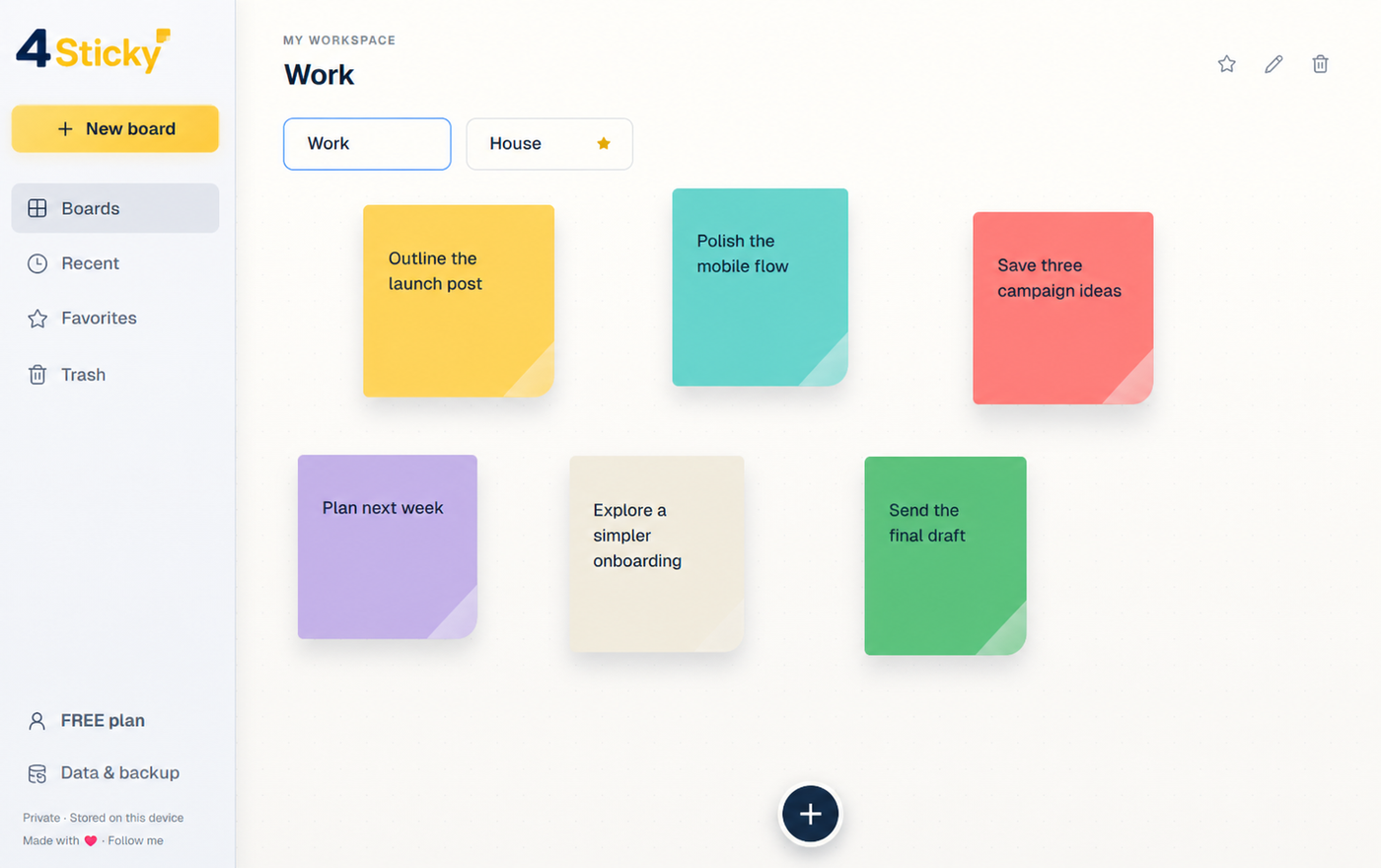
A visual board works well because you can see your ideas without forcing them into a rigid structure from the beginning.
Organization Should Happen Naturally
Good systems adapt to the way you think.
If you constantly have to stop and ask:
"Where should I save this?"
your system is probably adding friction.
Capture the thought first.
When several ideas start connecting, the structure becomes much easier to see.
Keep It Simple Enough to Use
The best productivity system isn't the one with the most features.
It's the one you actually use.
A simple board with a few notes can sometimes be more useful than a perfectly organized workspace full of folders, labels, and rules.
Your ideas don't need more complexity.
They need less friction.