

Why Your Best Ideas Disappear — and How to Capture Them Before They Do
Great ideas rarely arrive when you're ready for them.
They show up while you're driving, taking a shower, working on something completely different, or just before falling asleep. In that moment, the idea feels obvious — almost impossible to forget.
Then, a few hours later, it's gone.
Your Brain Isn't a Storage System
We often assume we'll remember a good idea simply because it feels important. But your brain is constantly processing new information, switching contexts, and deciding what deserves attention.
An idea that feels crystal clear now can become a vague memory surprisingly quickly.
That's why one of the simplest habits you can build is also one of the most valuable:
Capture first. Organize later.
Don't worry about writing the perfect note. Don't decide which folder it belongs in. Just save enough information to bring the idea back to life later.
Make Capturing Ideas Effortless
The more steps required to save an idea, the less likely you are to do it.
A good idea-capturing system should be:
- Fast
- Always available
- Easy to understand
- Flexible enough for messy thoughts
Sometimes a few words are enough:
"AI tool for summarizing customer calls."
You don't need the business plan yet. You just need to make sure the thought survives.
Give Your Ideas Somewhere to Live
Once ideas are captured, visual organization can make them much easier to explore.
Sticky notes work particularly well because ideas don't always belong in rigid lists. You can move them around, group related thoughts, separate priorities, and gradually discover connections.
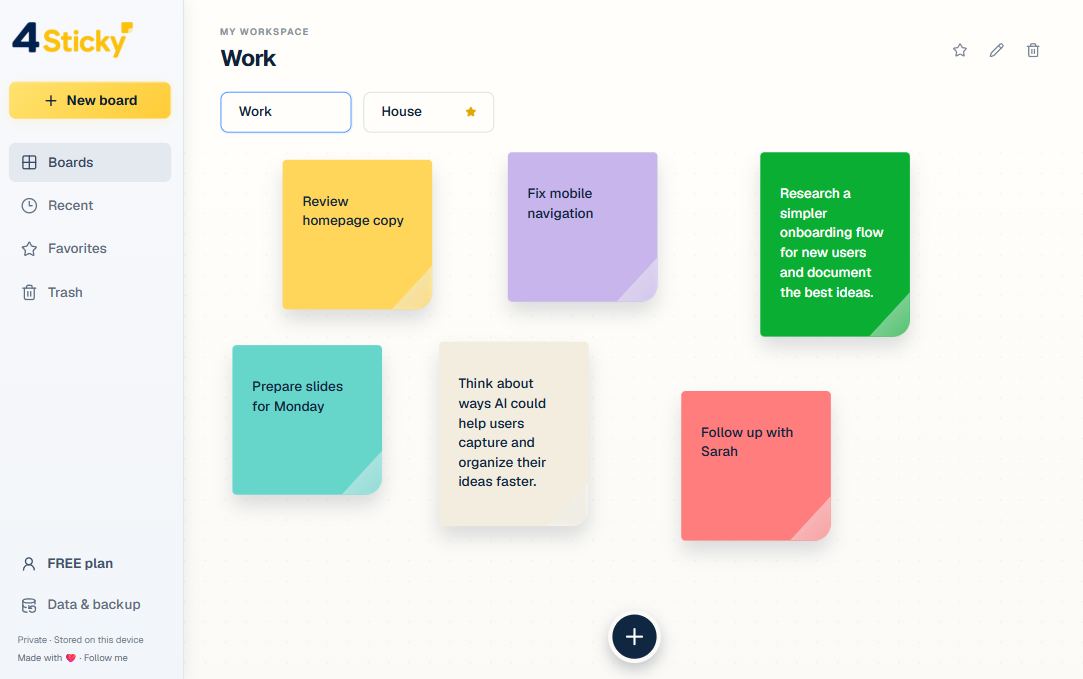
This is the idea behind tools like 4Sticky: give your thoughts a simple visual space where you can capture them quickly and organize them when you're ready.
Don't Judge Ideas Too Early
Not every idea you save will become something important.
That's okay.
An idea that looks useless today might connect with another thought three months from now. A small observation might eventually become a feature, an article, a project, or even a business.
Your job when inspiration appears isn't to decide whether the idea is brilliant.
Your job is simply to not lose it.
Capture Now. Decide Later.
You don't need a complicated productivity system to protect your ideas.
You need a place you trust enough to use immediately.
The next time an interesting thought appears, don't tell yourself, "I'll remember that."
Write it down.
Your future self might be very glad you did.